
Science-based targets 101: What parent companies and subsidiaries need to know before setting targets
Jan 21st 2026
Should science-based targets be set at the parent (or group) company level, or can subsidiaries submit their own?
If your company has a complex structure, you might be wondering: Should science-based targets be set at the parent (or group) company level, or can subsidiaries submit their own?
It’s a common question — and the answer depends on how your organization is set up.
Who can set targets? The simple answer
In most cases, it’s often simpler and more effective for science-based targets to be submitted by the parent company. This approach helps to ensure consistency across the organization and can streamline reporting.
However, subsidiaries can submit their own targets independently, even if the parent company already has validated targets in place.
The key is ensuring all eligibility criteria are met. For parent companies, this means including emissions from all subsidiaries within your chosen boundary. For subsidiaries submitting independently, it’s crucial you clearly define emissions scope and explain your relationship to the broader group.
The role of organizational boundaries
Science-based targets are grounded in rigorous technical criteria and in robust greenhouse gas accounting principles that align with the Greenhouse Gas Protocol. To define which parts of your business and emissions are included, you’ll need to apply one of three consolidation approaches under the Greenhouse Gas Protocol:
- Financial control: You have authority over the financial and operating policies of an entity.
- Operational control: You have the ability to implement operating policies, such as holding the operating license.
- Equity share: You account for emissions in proportion to your share of equity in the operation, reflecting your economic interest.
As part of the validation process, you must disclose the consolidation your company has chosen, upload a CSV file through the SBTi Services Validation Portal showing your ownership stakes in different entities, and clearly identify any exclusions.
Target submission at the parent-level
Targets should be submitted at the parent-level whenever possible. This expectation is built into the boundary criteria detailed in the Corporate Near-Term Criteria and the Corporate Net-Zero Standard, and further reinforced through our Criteria Assessment Indicators (CAI).
The entity submitting targets should be a legally recognized company with the authority to represent the group.
When the parent company submits targets, it must:
- Use an appropriate consolidation method in line with the Greenhouse Protocol—such as financial control, operational control, or equity share—and explain why this approach is appropriate.
- Provide a CSV file listing all entities included in the boundary (e.g. subsidiaries and joint ventures) and the percent of equity held.
- Include all subsidiaries within the chosen consolidation boundary.
- Ensure any mergers, acquisitions or divestments are reflected in the GHG inventory within a reasonable timeframe—recommended as by the end of the next reporting year.
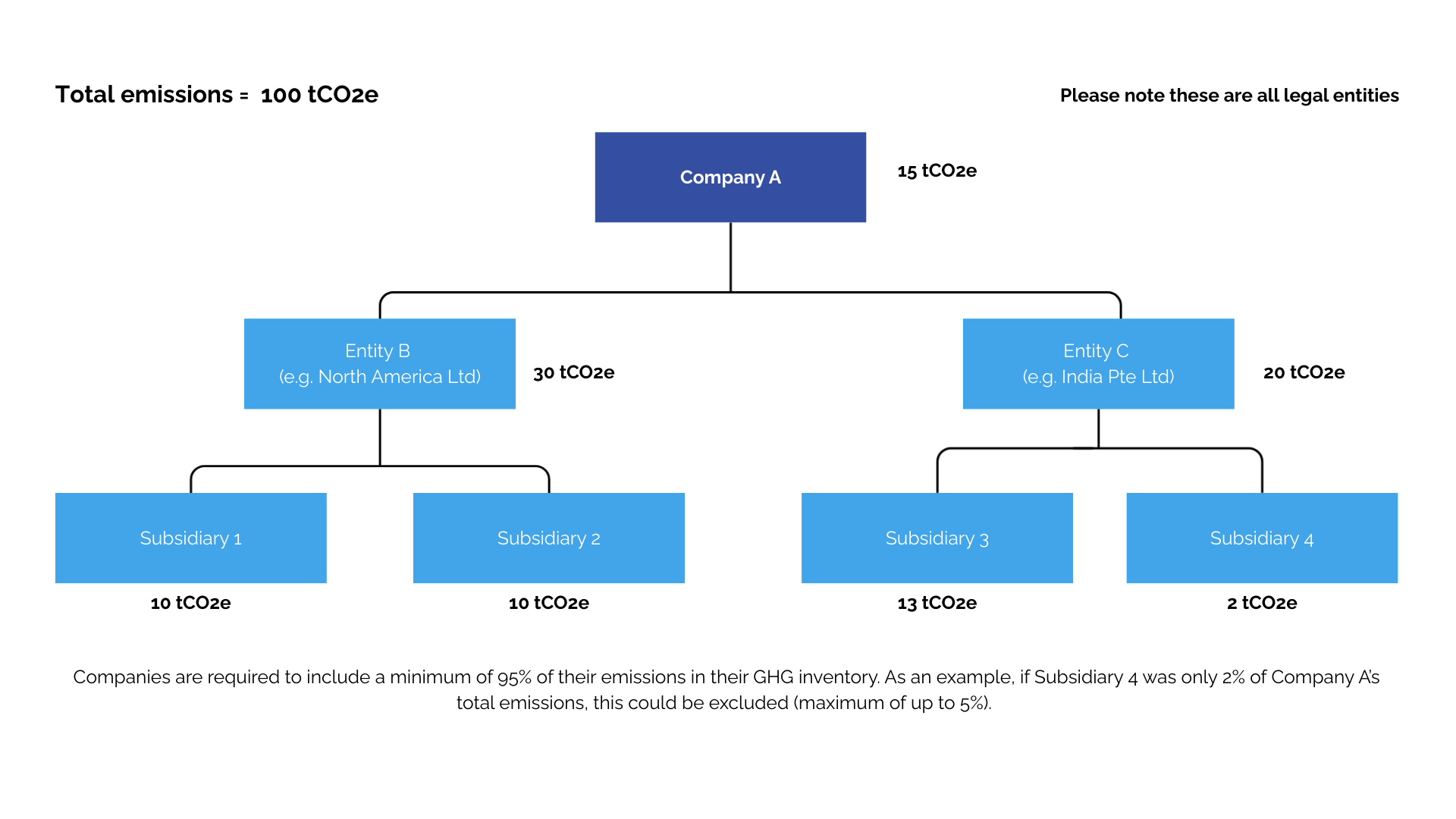
- Identify any excluded entities, quantify their emissions and explain why they are not included. Exclusions must not exceed 5% of total scope 1, 2 and 3 emissions.
- For corporates, list any entities where the company holds an equity stake but does not have control under the chosen consolidation approach, and report associated emissions in scope 3 category 15. This applies to all consolidation approaches aside from equity share.
The diagram below shows a typical submission at the parent-level. It reflects how the parent company defines its target boundary to include all relevant subsidiaries and joint ventures using the chosen consolidation method.
When can subsidiaries submit targets?
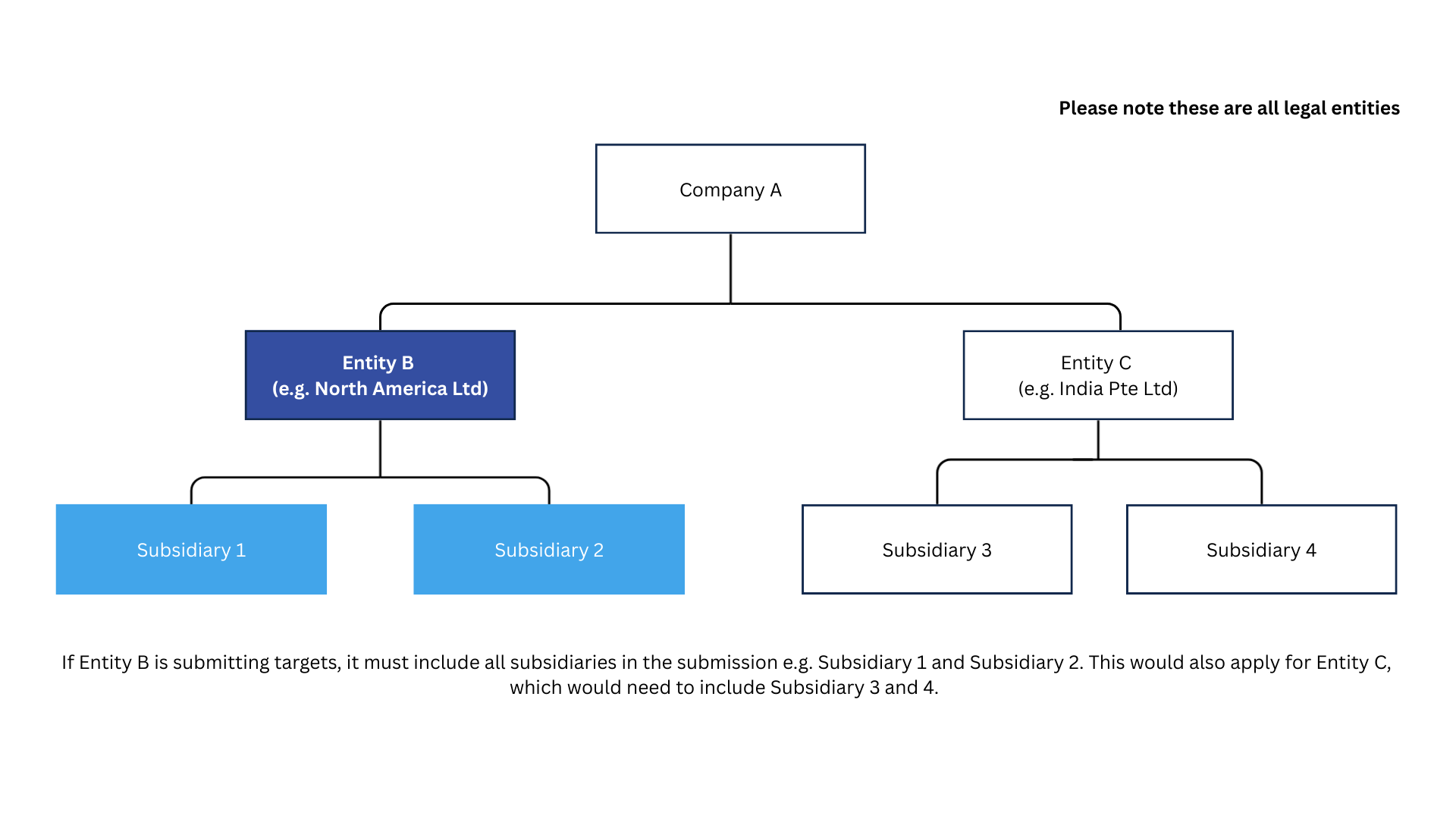
While parent-level submission is the recommended approach, subsidiaries can also submit their own targets. Some subsidiaries may choose this route if their parent company isn’t ready to set targets yet, or when a subsidiary wants to move faster or adopt a more ambitious pathway than the wider group.
Subsidiaries would need to meet the same criteria as parent companies, ensuring consistency across all target submissions. This means they must be a legally defined entity, independent from the parent company.
A subsidiary submitting targets must:
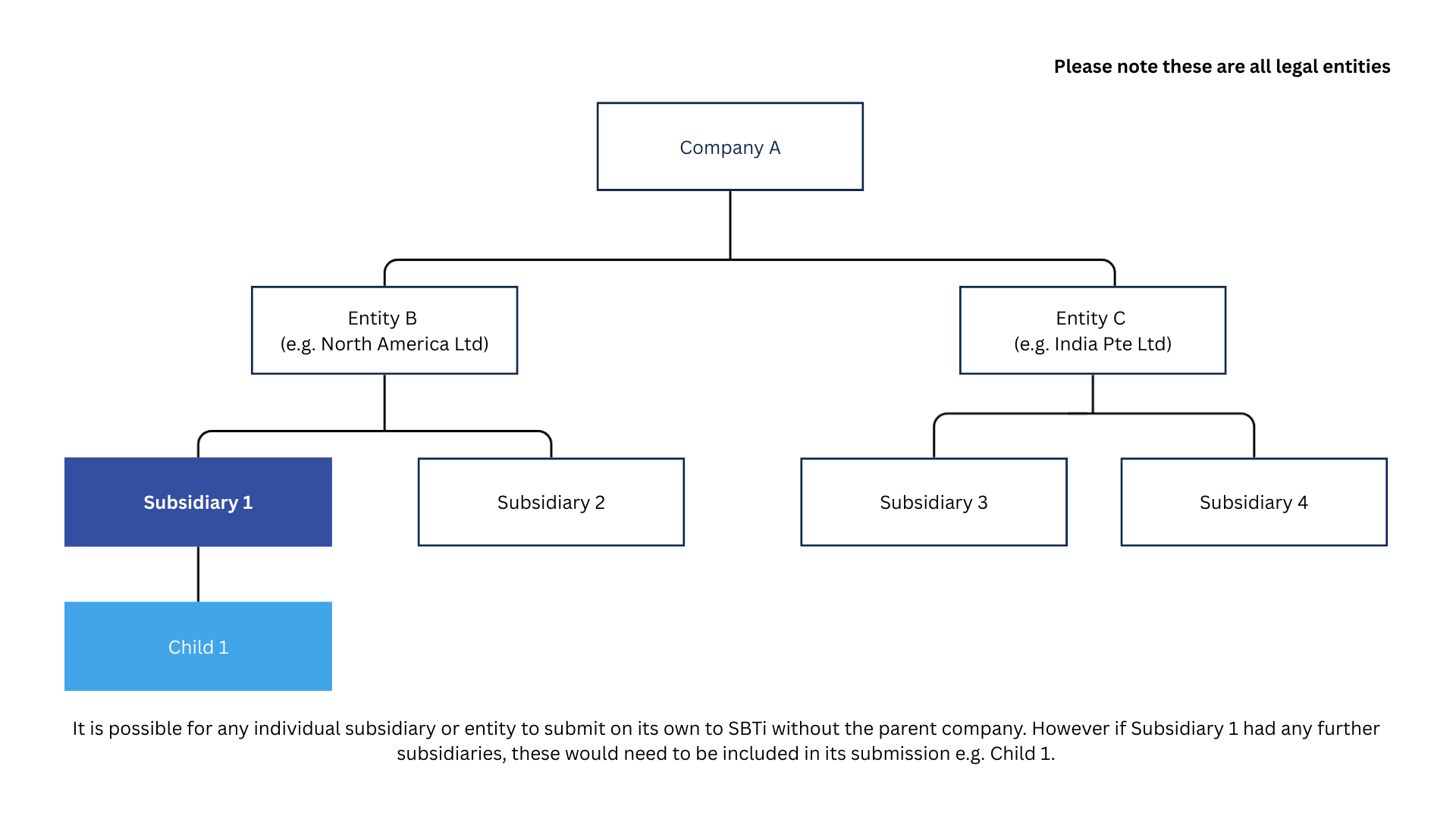
- Include all entities under its control within the target boundary.
- Apply a valid consolidation approach aligned with the Greenhouse Gas Protocol—financial control, operational control, or equity share.
- Follow the same rules on exclusions as parent companies:
- No more than 5% of emissions may be excluded from scope 1 and 2, and separately from scope 3.
- Any exclusions must be quantified and clearly explained.
Here’s what this can look like in practice:
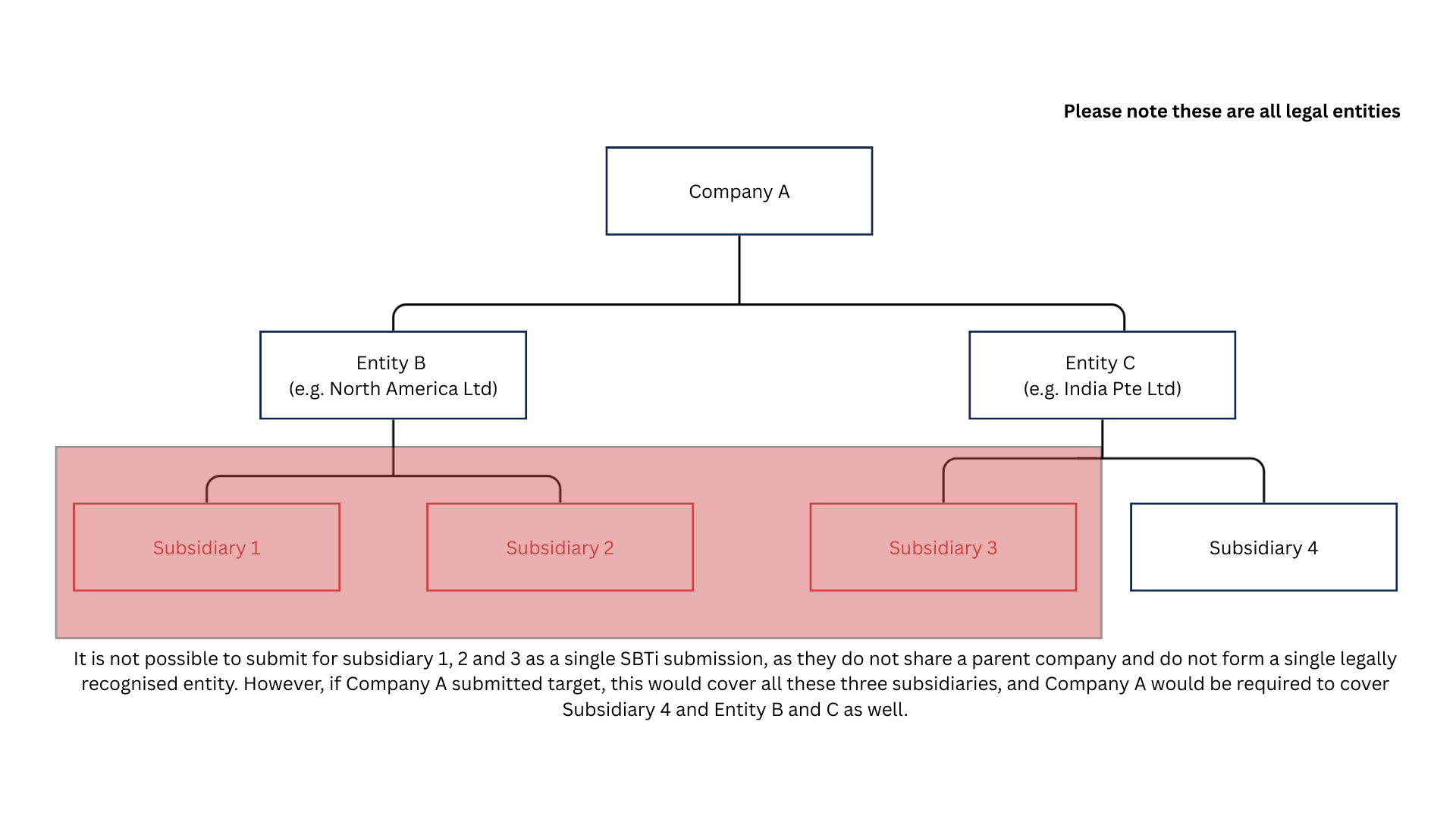
However, not all submissions from subsidiaries will meet the SBTi's criteria. For example, multiple subsidiaries or business units cannot submit a single shared target, unless they are legally consolidated under one parent company:
Need help defining your boundary?
If your company is preparing to develop science-based targets and isn’t sure whether to submit at the group or entity level, we recommend reviewing the following:
Clear documentation, appropriate boundary choices, and early alignment across entities will help ensure your target submission is more efficient.
Communicating about your company’s targets
When talking about your science-based targets, it’s important to be clear about which part of the business the targets apply to.
If a parent company has set and validated targets, its subsidiaries can talk about those targets - but they shouldn’t suggest the targets are their own. The same goes the other way: if a subsidiary has validated targets, the parent company can refer to them, but shouldn’t imply they apply to the whole group.
This helps avoid confusion and ensures you're staying in line with SBTi guidance. If you're unsure how to communicate your targets, check our Communications Guidelines or get in touch at communications@sciencebasedtargets.org.
Ready to get started?
Visit the SBTi Services to learn more and begin your journey.
If you have questions or need support, contact us via the Validation Portal or info@sbtiservices.com
Whether your company is beginning its target-setting journey or simply interested in exploring the guidance and resources available, the SBTi Getting Started Navigator helps you find relevant information for your company in less than 30 seconds.
Follow us on LinkedIn, X and sign up for our newsletter to get the latest developments in science-based target setting.